The Avatar
 |
| "I'm Aang." From Book 1: Air - The Boy in the Iceberg |
 |
| "Long ago, the four nations lived together in harmony" From Book 1: Air - The Avatar Returns |
And in the midst of these four nations is the Avatar,
a being of spiritual energy incarnated in a human body with the power to wield all four elements of the separate nations. The Avatar is the upholder of peace among the four nations and the bridge between the spiritual and physical worlds. Each time the Avatar dies, the spirit within him or her is reincarnated in the next nation of the cycle: Water, Earth, Fire, Air, then back to Water.
The word "Avatar" comes from the sanskrit word meaning
"descent". In Hinduism it is a term closely tied to the god Vishnu, who is commonly believed to have ten primary avatars, which include Krishna and Buddha (nice little jab at Buddhism there!), called the dashavatara. The idea of an avatar cycle actually comes from a more modern interpretation which ordered the avatars from simple life forms (begining with Matsya, the fish) to more complex (ending with Kalki - advanced, with powers of great distruction) to serve as a parallel to the modern theory of evolution. This was first proposed by Helena Blavatsky, a Russian-German researcher of occult and esoteric "science", and later adapted by Orientalists and then Hindus in India, for the purpose of oriental hybridity (use of colonial discourses by the colonized to subvert colonial agendas in favor of their own), adding legitimacy to Hinduism as the religion most applicable with science.
Another smaller but very interesting nod to eastern religions is in the Avatar search process. In a flashback, Aang remembers
being told he is the Avatar by the monks who explain that they knew he was the Avatar because the toys he chose to play with all belong to past Avatar lives. This bears a striking resemblence to the search process used by the High Lamas of the "Yellow Hat" school of Tibetan Buddhism to discover the reincarnation of the Dalai Lama. When they arrive at the home of a boy who is suspected of being the new Dalai Lama, they present him with a number of artifacts, and if the boy chooses those artifacts which belonged to the previous Dalai Lama, it is considered a sign that he is the reincarnation.
a being of spiritual energy incarnated in a human body with the power to wield all four elements of the separate nations. The Avatar is the upholder of peace among the four nations and the bridge between the spiritual and physical worlds. Each time the Avatar dies, the spirit within him or her is reincarnated in the next nation of the cycle: Water, Earth, Fire, Air, then back to Water.
The word "Avatar" comes from the sanskrit word meaning
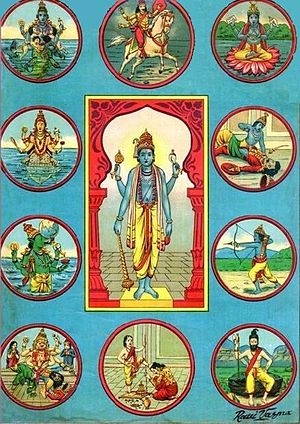 |
| The Ten Avatars of Vishnu, from top left moving counter-clockwise: Matsya, Kurma, Varaha, Narasimha, Vamana, Parashurama, Rama, Krishna, Buddha, and Kalki |
Another smaller but very interesting nod to eastern religions is in the Avatar search process. In a flashback, Aang remembers
 |
| "You chose them because they were familiar to you" From Book 1: Air - The Storm |

No comments:
Post a Comment