Search This Blog

Sunday, May 3, 2015


The Avatar State and Nirvana

You've heard it all before. Connection to the cosmic energy of the
Phenomenal Cosmic Power! From
Book 3: Fire - Sozin's Comet, Part 4
universe, separation from the limitations of our limited awareness. Whether it's called the avatar state, the force, falling down the rabbit hole, or nirvana, our culture is plenty aware of what buddhist are constantly trying to achieve, though we may not realize it. But it usually isn't as simple as taking a red pill (NOT LSD!) and waking up in wonderland - especially if you're a Buddhist; or Aang. The Avatar State is, according to Aang's past life Roku, a defense mechanism that allows the Avatar to tap into the combined power and experience of all his past lives. In it he is one with both the spiritual and physical worlds, the past and the present. 


This obviously draws inspiration from the Buddhist concept of nirvana, which is the extinguishment of dukkha, suffering caused by attachment, aversion, and ignorance. This is achieved through the Noble Eightfold Path, a long and arduous process of mindful and concentrated meditation. So what does the Avatar have to do to achieve the Avatar State? Pretty much the same thing! Except, instead of extinguishing dukkha via the Noble Eightfold Path, he meditates to clear up an imbalance of his chakras. 
"What are chakras?"
from Book 2: Earth - The Guru


The chakras are pools of spiraling energy in the body that play a central role in the Tibetan Buddhists quest for enlightenment. The goal of Tibetan Buddhism actually differs from that of most Buddhists, as, instead of wanting to achieve enlightenment for escape from reality, they strive to attain "buddhahood" in order to better serve others and help them achieve the same enlightenment. This is a perfect parallel to the Avatar's use of the Avatar State, to better keep the world in balance, not to detach from it. 

There are seven chakras, following the spine from the base of the back to the crown of the head. The Earth chakra, located at the bass of the spine, deals with survival, and in the show is blocked by fear; the water chakra, located in the pelvis, deals with pleasure and is blocked by guilt; the Fire chakra, located in the stomach, deals with willpower and is blocked by same; the heart chakra, located... yeah you know, deals with love, and is blocked by grief; the sound chakra, located in the throat, deals with truth and is blocked by lies; the light chakra, located in the center of the forehead, deals with insight and is blocked by illusion (especially the illusion of separation - because all living beings are in fact interconnected); and the thought chakra, located at the crown of the head, deals with pure cosmic energy and is blocked by earthly attachments. 

And as to be expected, Aang has a problem with this last one, especially when he sees a vision of one such earthly attachments in danger, and decides to halt his training to go save them. Almost like a certain wannabe Jedi we know, hm? Well thankfully do to a conveniently placed deus ex machina in the final act of the serious, Neo, I mean Aang eventually manages to achieve full control of the Avatar State and save the world anyway because, lest you forget, this is a kids show. A very complex and thought provoking kids show, but a kids show none the less.

Learning Mindfulness from Bumi and Toph

Several months after he emerged from ice, Aang, having mastered water-bending returns to the Earth Kingdom city of Omashu to get his friend King Bumi to teach him earthbending, only to find it under occupation by the Fire Nation. Desperate to save his friend, Aang goes in to rescue him, only to discover that Bumi doesn't need or want to escape! He is simply waiting for the opportune moment to take back his city. He tells Aang that that is the key to earthbending and that Aang's teacher would be someone who waits and listens before striking. 


"It wasn't just about fighting. It was
their way of interacting with the world"
From Book 3: Fire - The Firebending Masters
This individual is soon introduced to us in the form of Toph Beifong, a blind girl from a privileged family who,  feeling overprotected and stiffled ran away from home and when lost and scared in a cave was found by the original earthbenders, the badgermoles (just go with it), who, also blind, taught her earthbending. 


"I see with earthbending... I feel the
vibration in the earth, and I 'see' where
everything is"
From Book 2: Earth - The Blind Bandit
Although most earthbending humans in the Avatar universe use earthbending as a blunt instrument of action and attack, Toph, by necessity, uses a much more immersive approach, listening to the air around her and feeling the earth beneath her. Without the easy out of vision, she must be mindful of the world around her in order to survive. 

Mindfulness comes from a pali word "sati", which is an essential aspect of the Eightfold Path of Buddhism, the steps which, according to Buddhist doctrine, are necessary for achieving nirvana (more on that in a later post). This "version" of mindfulness, however, is actually based on the "westernized" interpretation of mindfulness which, although also based on present-moment awareness, is directed towards becoming more in-tune with the world (rather than the Eightfold Path's goal of separation from the world). Popularized by Jon Kabat-Zinn, this psychology-based application of mindfulness is used in the west to facilitate cognitive therapy, behavioral therapy, and most of all, stress reduction.
"Taking back my city!"
From Book 3: Fire - Sozin's Comet, Part 2
The concept is, like King Bumi, to not try to escape from your current situation, but to acknowledge it without negativity and open yourself up to prepare for an eventual change, but without forcing it or trying to enact change yourself. And sure enough, a half a year of waiting and listening later, Bumi got the chance he was waiting for! 


The Avatar


"I'm Aang."
From Book 1: Air - The Boy in the Iceberg
Meet Aang, the Last Airbender, and also the most recent in a long line of Avatars. In this universe, all people of the world belong to one of four nations: the Fire Nation, an empire of honor and pride where power is valued above all else; the Earth Kingdom, a monarchy of order and fortitude that adheres to a message of peaceful coexistence; the Water Tribes, sister tribes at the north and south pole respectively, who live in peaceful communion with nature and teach the importance of family; and the Air Nomads, the smallest group, spiritual people who separated themselves from the material and political world and built temples hidden away in the mountains where they would retreat to meditate and seek enlightenment. 
"Long ago, the four nations lived
together in harmony"
From Book 1: Air - The Avatar Returns


And in the midst of these four nations is the Avatar,
 a being of spiritual energy incarnated in a human body with the power to wield all four elements of the separate nations. The Avatar is the upholder of peace among the four nations and the bridge between the spiritual and physical worlds. Each time the Avatar dies, the spirit within him or her is reincarnated in the next nation of the cycle: Water, Earth, Fire, Air, then back to Water. 


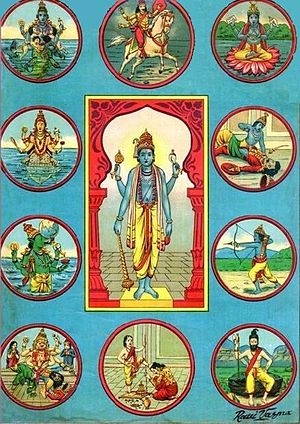
The word "Avatar" comes from the sanskrit word meaning 
The Ten Avatars of Vishnu, from top left
moving counter-clockwise: Matsya, Kurma,
Varaha, Narasimha, Vamana, Parashurama,
Rama, Krishna, Buddha, and Kalki

"descent". In Hinduism it is a term closely tied to the god Vishnu, who is commonly believed to have ten primary avatars, which include Krishna and Buddha (nice little jab at Buddhism there!), called the dashavatara. The idea of an avatar cycle actually comes from a more modern interpretation which ordered the avatars from simple life forms (begining with Matsya, the fish) to more complex (ending with Kalki - advanced, with powers of great distruction) to serve as a parallel to the modern theory of evolution. This was first proposed by Helena Blavatsky, a Russian-German researcher of occult and esoteric "science", and later adapted by Orientalists and then Hindus in India, for the purpose of oriental hybridity (use of colonial discourses by the colonized to subvert colonial agendas in favor of their own), adding legitimacy to Hinduism as the religion most applicable with science. 

Another smaller but very interesting nod to eastern religions is in the Avatar search process. In a flashback, Aang remembers
"You chose them because they were
 familiar to you"
From Book 1: Air - The Storm 
 being told he is the Avatar by the monks who explain that they knew he was the Avatar because the toys he chose to play with all belong to past Avatar lives. This bears a striking resemblence to the search process used by the High Lamas of the "Yellow Hat" school of Tibetan Buddhism to discover the reincarnation of the Dalai Lama. When they arrive at the home of a boy who is suspected of being the new Dalai Lama, they present him with a number of artifacts, and if the boy chooses those artifacts which belonged to the previous Dalai Lama, it is considered a sign that he is the reincarnation. 


Introduction to Religion in the Avatar Universe
Image result for avatar it's the quenchiest
"Friendly Mushroom! Mushy Giant Friend"
from Book 2: Earth - The Desert

The Avatar's past lives
from Book 3: Fire - Sozin's Comet, Part 4
In 2005, the kids programing network Nickelodeon premiered a new series that was unlike any other typical "kids" show that had ever aired on the network before. Avatar: The Last Airbender was full of culture, complex character growth, and yes, lots of incredibly quotable humor. 

But beyond that, the mythos behind the world of the Avatar Universe has very clear connections to real-world religions and cultures. From the mindful awareness of the blind earthbender Toph, to the spiritual detachment of the air nomads, to the reincarnation of the Avatar cycle, all of these elements and more can be definitively connected to real influences. In this blog I will be exploring the different elements of this incredible world and how each draw from the religions and cultures of our world (particularly those in the East).